Cycling has a language of its own. Someone suggests a “steady no-drop café spin”, another rider mentions their groupset, and somebody at the back announces they’re about to bonk. You could reasonably wonder whether you’ve joined a bike ride or wandered into a peculiar private club.
Most of these expressions describe straightforward things. This guide translates the technical terms and everyday riding phrases, so you can follow the conversation, understand buying advice and order your cake with confidence.
Out on a ride
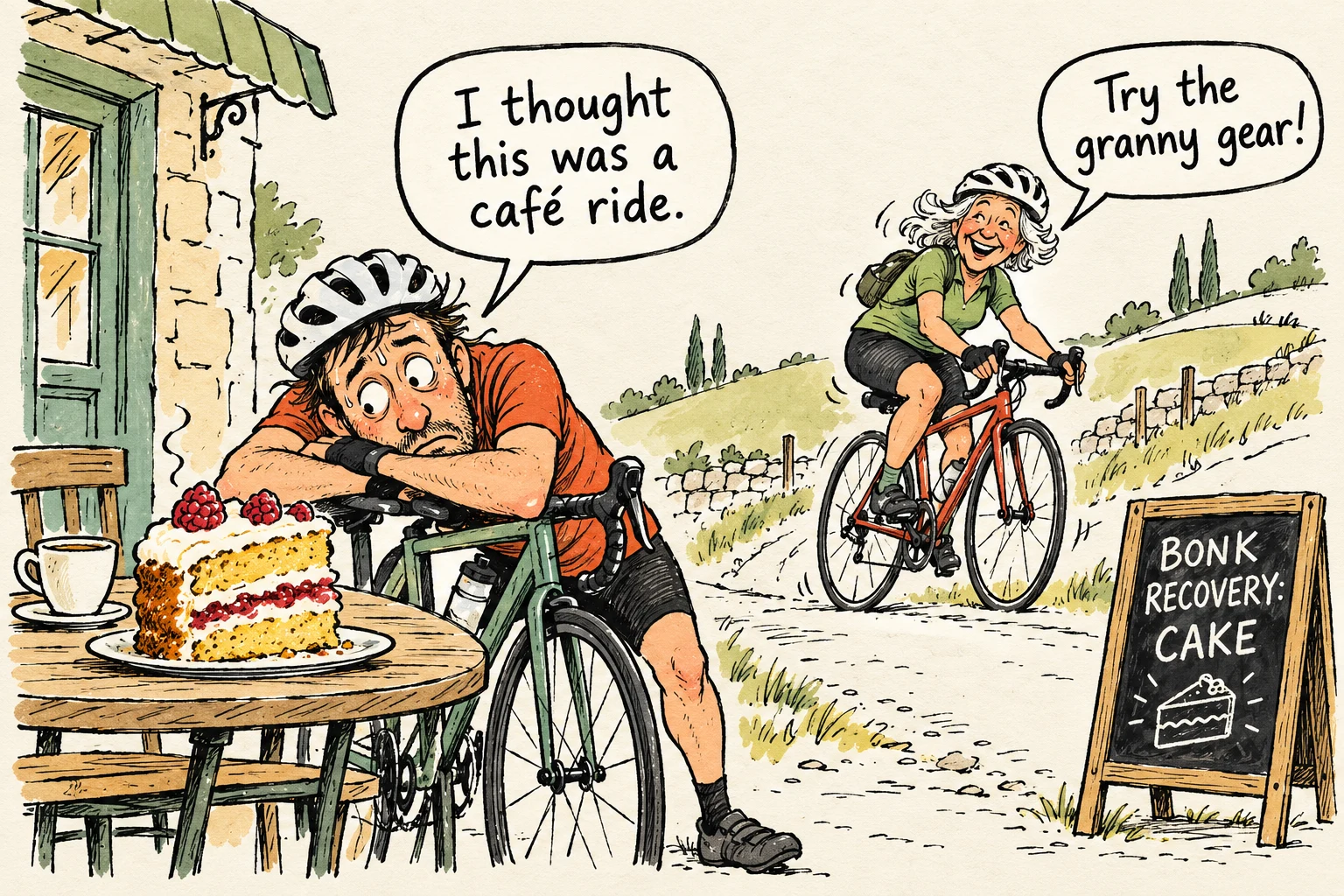
Bonking
Running very low on energy during a ride, commonly associated with depleted carbohydrate reserves after prolonged exercise. Your usual pace suddenly feels difficult, and the next few miles can look considerably longer than they did earlier.
In a cycling conversation, “I’m about to bonk” usually means food is urgently moving up the agenda. Eat regularly on longer rides rather than waiting until you feel empty. Feeling faint or unwell is a reason to stop, not something to push through for the sake of a phrase.
Spinning
Pedalling at a relatively quick rhythm in an easier gear. Each pedal stroke takes less force than slowly pushing a harder gear.
“Spin up this hill” means choose an easier gear and keep your legs turning comfortably. It does not mean you need to pedal like a washing machine on its final cycle.
Grinding
Pedalling slowly against a hard gear. You might hear “I was grinding up that climb.”
If every stroke feels like a wrestling match, an easier gear may help. Sometimes you’ve simply run out of easier gears—which is useful information when choosing your next bike.
Cadence
How quickly you turn the pedals, usually measured in revolutions per minute, or rpm.
You don’t need a number on a screen to recognise the difference between comfortable pedalling and struggling to turn the cranks. Start with a rhythm that feels manageable.
The granny gear
An affectionate nickname for your easiest climbing gear.
It is there to help you get uphill. Use it. Nobody at the summit is handing out medals for making the journey unnecessarily miserable.
A café ride
A ride with a café stop as part of the plan. Often sociable, sometimes leisurely, occasionally suspiciously fast between cake shops.
The name does not guarantee an easy pace. Ask about distance and speed before joining. “There will be cake” is reassuring, but it is not a difficulty rating.
A no-drop ride
A group ride organised so riders are not left behind. The group may regroup at junctions or have someone looking after the back.
You still need to check the expected pace, distance and terrain. No-drop should mean supported, not that any route will suit every rider.
On your wheel
Riding close behind another cyclist. You might hear it as a warning that someone is following you.
Close group riding requires attention and predictable movement. Beginners should leave comfortable space and learn with an experienced group rather than immediately trying to tuck themselves inches behind a stranger.
Taking a turn
Spending time at the front of a group, where you face more of the wind.
It is a way of sharing the effort. On a friendly ride, a short, comfortable turn is more useful than an heroic effort followed by needing to lie down beside a hedge.
A mechanical
A problem with the bike: a dropped chain, damaged component or another fault that interrupts the ride.
“I’ve had a mechanical” is convenient shorthand. Once everyone stops, a more specific description helps: what happened, what is moving and what is stuck?
A puncture
A tyre losing air because the tube or tyre has been damaged.
You may also hear “a flat”. Neither expression tells you what caused it, so check for the offending thorn, glass or other damage before fitting a replacement tube.
Headwind
Wind blowing against your direction of travel. It increases the effort needed to maintain your speed.
If you’re working harder than usual on a flat road, the wind may be doing rather more than the scenery suggests.
Tailwind
Wind blowing roughly in your direction of travel.
Enjoy it. Just remember that a wonderfully easy outward journey can become a rather educational return trip.
Choosing a bike
Road bike
A bike designed mainly for riding efficiently on paved roads. Most have drop handlebars, which curve downwards and offer several hand positions.
A road bike need not be a racing machine. Some are designed around comfort and longer outings rather than an aggressive riding position.
Hybrid
A broad category of bike combining features suited to everyday road riding and some less demanding paths. Hybrids commonly have flat handlebars.
The label covers a wide range. Look at the tyres, gearing and riding position rather than assuming all hybrids are alike.
Gravel bike
A bike intended for a mixture of roads and unpaved surfaces, usually with drop handlebars and space for wider tyres than a typical road bike.
“Gravel” does not mean every rough track is suitable. Tyres, skill, luggage and the condition of the route still matter.
Endurance bike
Usually a road bike designed to make longer rides more comfortable, often with a less stretched riding position than a race-focused model.
It is an appealing word, but fit matters more than the label. A comfortable bike is one that suits your body and riding.
Geometry
The measurements and angles of a bike’s frame. Together, they influence fit, riding position and handling.
When someone says a bike has “relaxed geometry”, they generally mean it prioritises a less aggressive position or calmer handling. Ask what that means for the particular bike.
Bikepacking
Travelling by bike with luggage carried in bags attached around the frame, handlebars and saddle. It is often associated with lightweight equipment and unpaved adventures.
It does not require sleeping in a ditch or treating a shower as a moral failing. Short trips and comfortable accommodation count too.
Touring
Travelling by bicycle, whether for a weekend or a much longer journey. Touring often involves luggage and a route between overnight stops.
The important ingredient is the journey, not suffering. Hotels, luggage transfers and leisurely lunches are perfectly legitimate touring choices.
Gears and the bits that make you move
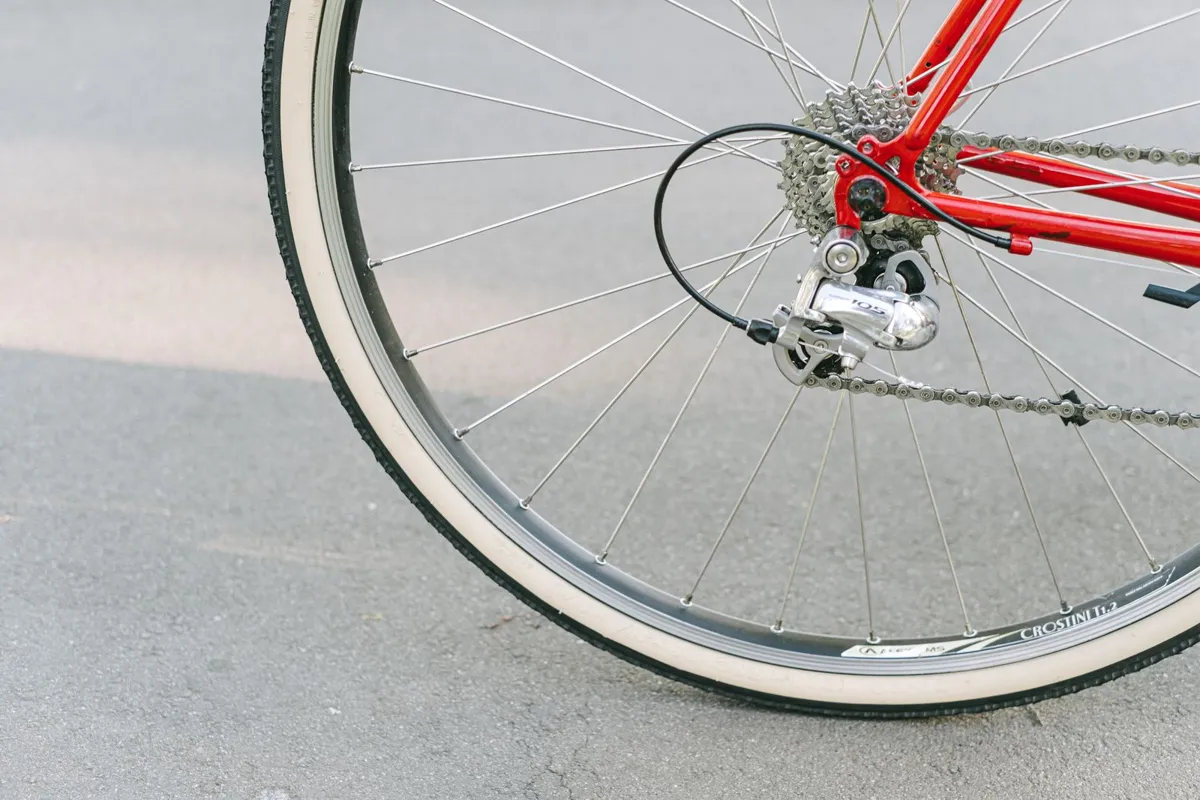
Drivetrain
The components that transfer your pedalling effort to the rear wheel. On a typical geared bike, this includes the chain, chainrings, rear sprockets and gear-changing components.
It is the working system, rather than one individual part.
Groupset
A collection of components sold as a range, generally including the gears and brakes. The exact contents depend on the manufacturer and system.
A bike advertised with a particular groupset may still use some components from other ranges. Read the actual specification.
Chainring
A toothed wheel beside the pedals, around which the chain runs. A bike may have one, two or sometimes three.
The number of chainrings affects how the gearing is arranged. More chainrings do not automatically mean a better bike.
Cassette
The cluster of rear sprockets—the toothed wheels that many riders simply call their rear gears.
Its range helps determine how easy your lowest gear can be, together with the front chainring. It also needs to be compatible with the rest of the system.
Derailleur
The mechanism that moves the chain between gears. A rear derailleur moves it across the cassette; a front derailleur moves it between chainrings.
Despite the name, its normal job is to put the chain where you want it, not derail your afternoon.
1x, or “one-by”
A drivetrain with one front chainring and several rear sprockets.
It simplifies gear selection because there is no front shift. Whether it suits you depends on the available gear range and the jumps between gears.
Gear ratio
The relationship between the size of the front chainring and the rear sprocket you are using.
An easier ratio helps you pedal uphill with less force at the pedals. You do not need to do the mathematics on every ride, but it helps explain why two bikes with the same number of gears can feel very different.
Electronic shifting
A system that uses electronic controls and powered mechanisms to change gears.
It can provide convenient, consistent shifting, but it brings batteries and charging into the ownership routine. Check the particular system rather than assuming all electronic gears work identically.
Brakes, wheels and tyres
Disc brakes
Brakes that act on a metal disc attached near the centre of the wheel, rather than squeezing the wheel rim.
That metal disc is called the rotor.
Hydraulic brakes
Brakes that transmit force through fluid in a sealed system.
They can offer effective braking with relatively light lever effort. They also require the right servicing procedures; topping up with whatever fluid is in the garage is not a plan.
Mechanical brakes
In this context, brakes operated by a cable.
You can have mechanical disc brakes or cable-operated rim brakes. “Disc” describes where the brake acts; “mechanical” describes how it is operated.
700C
A common wheel-size designation used on road, gravel and hybrid bikes.
It does not mean every tyre marked 700C will fit every such bike. Tyre width, rim suitability and frame clearance still need checking.
Tubeless
A tyre setup that holds air without an inner tube, using compatible tyres, rims and usually liquid sealant.
Sealant can close some small punctures, but tubeless does not mean puncture-proof. You still need a repair plan.
PSI and bar
Two units used to express tyre pressure.
The appropriate pressure depends on the tyre, rider and luggage weight, surface and equipment limits. More pressure is not automatically faster or more comfortable.
Rolling resistance
The energy lost as a tyre rolls and deforms.
Tyre construction, pressure and surface all matter. A tyre that looks fast is not necessarily the best choice for your actual roads.
Electric bikes
Pedal assistance
Motor assistance provided while you pedal, subject to the bike’s system and applicable rules.
It helps with the effort; it does not make steering, braking or choosing a suitable route somebody else’s responsibility.
Torque
Turning force. E-bike motor torque is commonly stated in newton-metres, written as Nm.
It is one useful specification, especially when considering climbing, but a bigger figure alone does not tell you how the complete bike will feel.
Watt-hours, or Wh
A measure of energy stored in a battery.
A larger Wh figure can mean more available energy, but range also depends on assistance level, hills, temperature, load and other conditions. Treat a headline range as a claim to investigate, not an appointment the battery has promised to keep.
Eco mode
Usually a lower-assistance setting intended to conserve battery energy.
The name and level vary between bikes. It is worth trying the different settings rather than spending every journey in the highest mode.
Routes, luggage and holidays
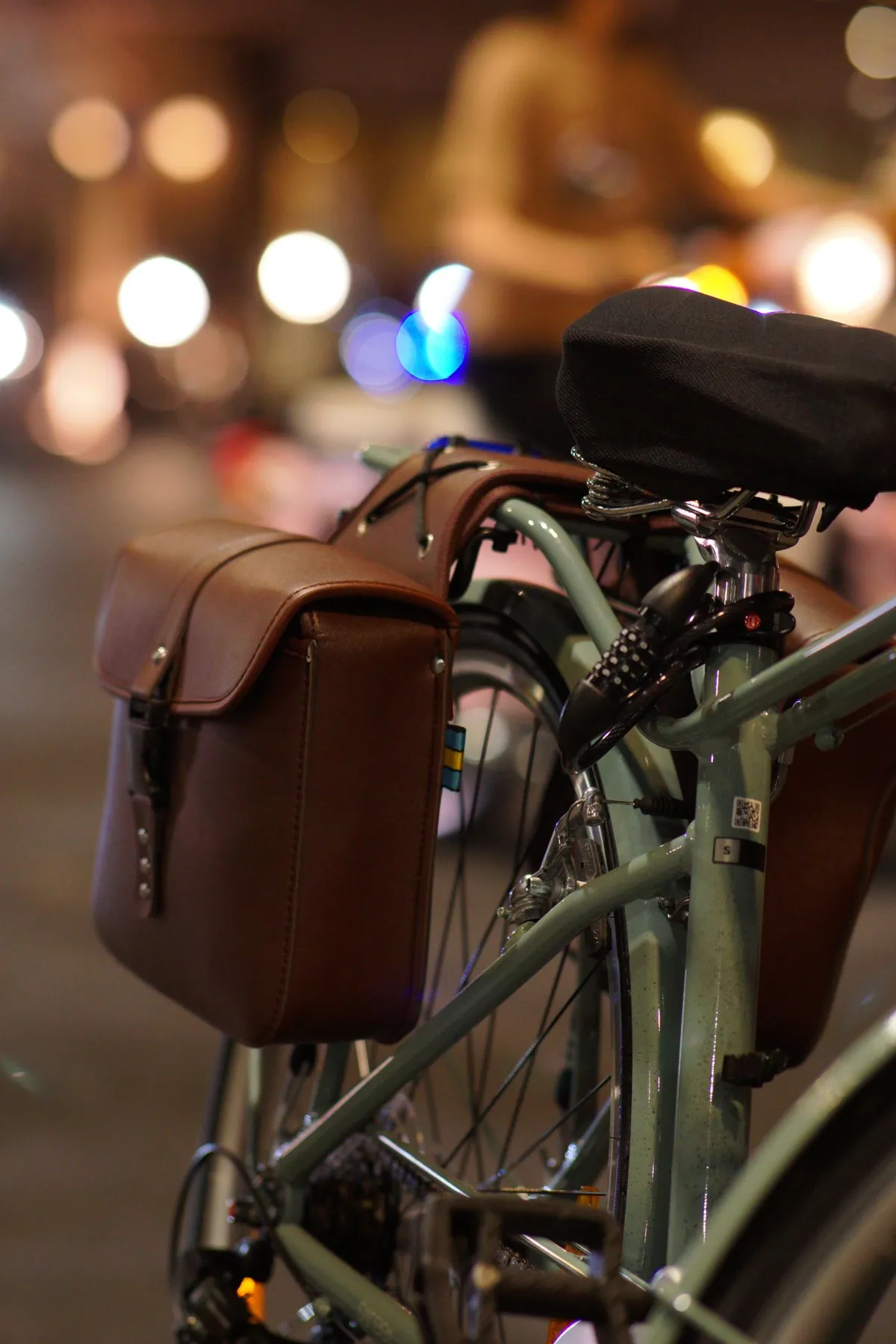
Panniers
Bags that attach beside a luggage rack, usually at the rear of the bike.
They keep luggage off your back, but need secure fittings and enough space that your heels do not strike them while pedalling.
GPX file
A digital file that can contain a route, track or location information for a navigation device or app.
It gives you a line to follow. It does not guarantee that the path is open, suitable, legal to ride or somewhere you will enjoy taking a loaded bike.
Ascent
The total amount of climbing over a route.
A ride can finish at the same elevation where it began and still contain plenty of ascent. Going back down does not refund the effort.
Self-guided holiday
A holiday where you follow the route without an accompanying guide. An operator may arrange accommodation, directions and luggage transfers.
You keep more control over stops and pace, while still needing to manage the day’s riding and reach the next overnight stop.
Luggage transfer
A service that moves your main bags between overnight accommodation while you ride with your day’s essentials.
It is not cheating. It is logistics—and quite pleasant logistics at that.
Supported ride
A ride with some form of organised help, which might include luggage transport, food stops, mechanical assistance or a vehicle.
Ask what is actually included. “Supported” is a description to clarify, not a guarantee that a van will appear whenever you fancy a lift.
And finally: N+1
N+1
The joke that the ideal number of bikes is one more than the number you currently own.
It is an excellent piece of cycling mathematics and a less reliable household budgeting strategy.
You do not need to learn all this before enjoying a ride. Ask when a term is unclear. Experienced cyclists were beginners once too—even the ones who now have very strong opinions about tyre pressure.
Join the discussion
What has worked for you? Share your experience or ask a question about this article.
Sign in with GitHub to comment. Your comment and GitHub profile name will be public. Comments appear when posted and may be moderated afterwards.
Keep replies relevant and respectful. No spam, personal information or unsupported accusations. Discussion and privacy information.