An electric bike adds assistance to your pedalling, but it still needs to fit your body, route and home. This guide explains how to choose the type of bike, assess range claims and plan charging and servicing. Start with the journeys you want to make rather than the motor’s biggest advertised number.
Choose a bike you can start and stop comfortably
A low-step frame may make getting on and off easier; a folding bike may help storage; a utility model may offer useful carrying equipment. Those are practical differences to try, not guarantees from the category name.
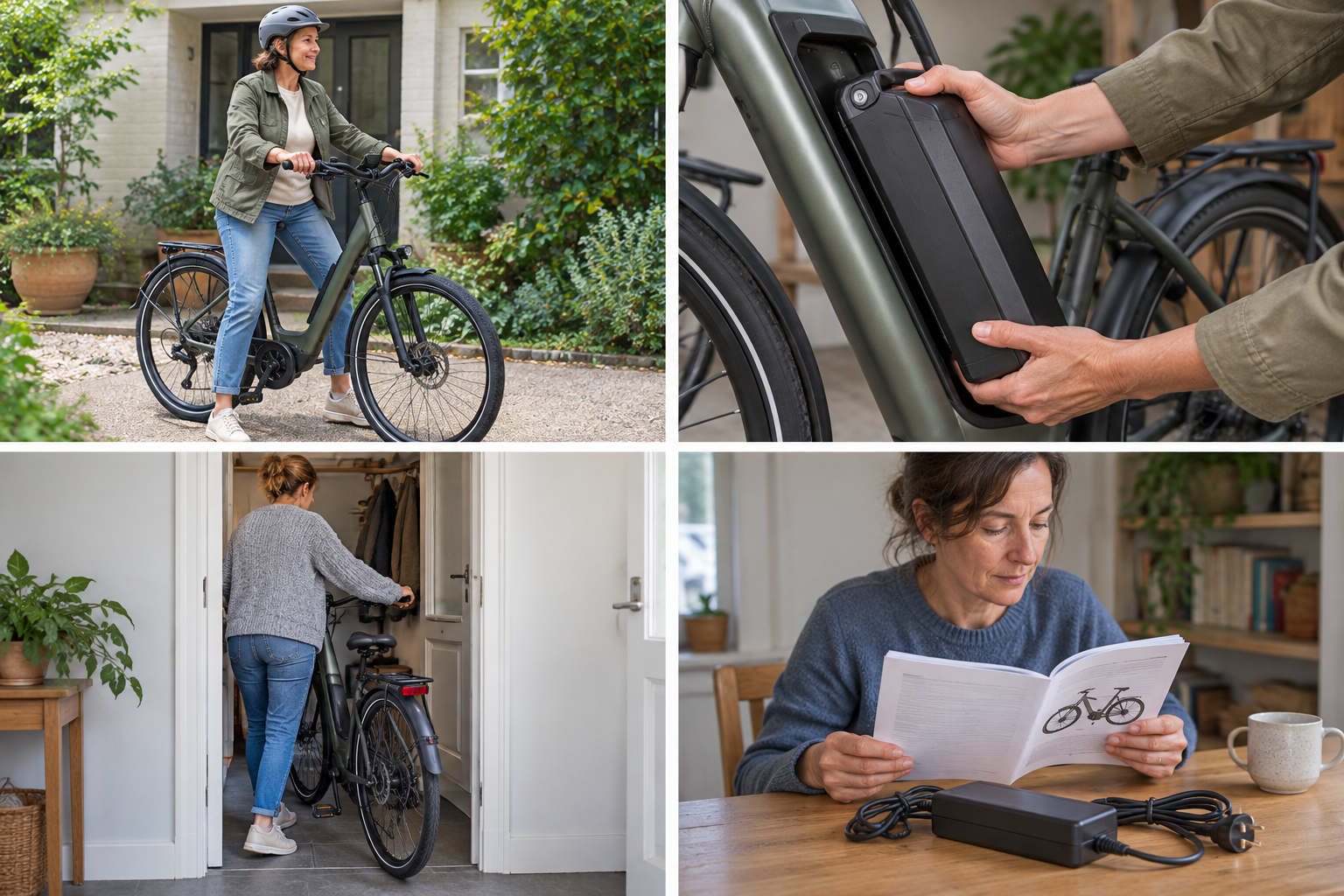
With a retailer’s suitable setup, practise mounting, starting in low assistance and stopping in a safe trial area. Repeat the sequence. Ask how the controls work and how assistance is turned off. Confidence at a junction matters as much as the ease of cruising along.
Understand battery capacity and range
Battery capacity is measured in Wh (watt-hours, stored energy). Motor power uses W (watts). More stored energy can help range, but rider load, hills, assistance level, weather and tyres affect how quickly it is used. Ask what assumptions sit behind an advertised distance.
A hypothetical 400Wh battery at 8Wh per kilometre gives 50km; at 12Wh per kilometre it gives about 33km. These are arithmetic examples, not promised range. Plan a reserve for the return journey and learn actual consumption on familiar rides after purchase.
Include charging and storage in the trial
If the battery is removable, ask to practise removal and handling. Establish where charging will happen and follow the maker’s battery and charger instructions. Removable does not necessarily mean easy for you to lift or carry.
Try the route through your doorway and any necessary lifting with the actual bike where possible. Consider luggage and overall width as well as weight. A comfortable ride is less useful if every arrival home becomes a struggle.
Check support and the finished price
Request a quotation with the accessories you need and ask which local workshop services the electrical system. Keep the warranty, exact model information and charging instructions. Establish the completed bike’s legal classification before purchase.
Great Britain’s EAPC (electrically assisted pedal cycle) rules include working pedals, a motor rated at no more than 250W continuous power and assistance ending above 15.5mph; some throttle arrangements require approval. Read the official guidance below. Choose a bike that meets the route, storage and support needs together, rather than choosing on range alone.
Check Great Britain’s assisted-bike rules
Great Britain has a defined category for electrically assisted pedal cycles, or EAPCs. A bike advertised as electric may fall outside it. Check the exact model and assistance arrangement before assuming you can use it as an ordinary bicycle.
What to confirm
- In Great Britain, an EAPC (electrically assisted pedal cycle) must have working pedals.
- Its continuous rated motor output (the rated sustained power, not a brief peak) must not exceed 250W.
- Motor assistance must cut off above 15.5mph.
- Riders must be at least 14.
- Other configurations may fall under motorcycle or moped requirements.
- Throttle-controlled models (models using a control to command assistance) have additional approval considerations.
Join the discussion
What has worked for you? Share your experience or ask a question about this article.
Sign in with GitHub to comment. Your comment and GitHub profile name will be public. Comments appear when posted and may be moderated afterwards.
Keep replies relevant and respectful. No spam, personal information or unsupported accusations. Discussion and privacy information.