Mountain, gravel and hybrid bikes overlap, which is why the category name alone can leave you more confused. This guide explains their usual strengths, the differences in handlebars and suspension, and how to compare actual bikes for your routes. Start with the riding you do regularly, not the most extreme ride you can imagine.
Where a hybrid makes sense
Hybrids commonly use flat handlebars and offer a broad road-and-path approach. For ordinary commuting, errands and maintained paths, look for a suitable riding position, useful low gears and approved luggage and mudguard mounts on the exact model.
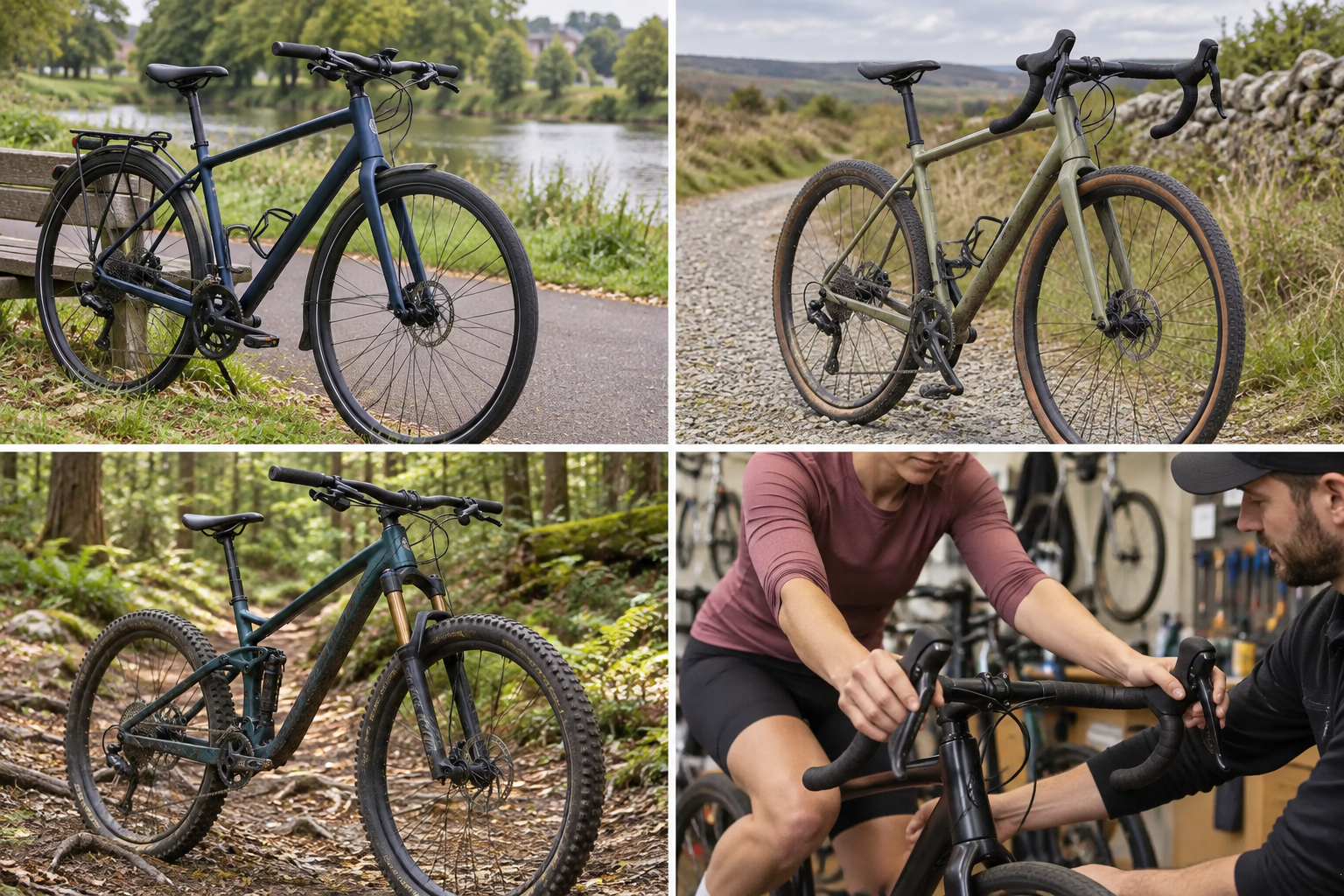
Write down distance, hills, roughest regular surface and what you carry. A luggage-capable hybrid can be a practical starting point when most riding is paved. The label covers varied designs, so check the equipment and intended use rather than assuming every hybrid is the same.
What a gravel bike adds
Gravel bikes are designed around mixed-surface riding and commonly have drop handlebars (bars curving downwards with several hand positions). Some use flat bars. Tyres, gearing and clearances vary considerably between models.
Try the normal hand positions and brake reach. Extra hand positions are useful only if the fit is comfortable for you. If commuting, still check racks and mudguards; a bike capable of rough tracks need not have the carrying arrangement you want.
When mountain-bike suspension earns its place
Mountain bikes emphasise rough-terrain control. A hardtail has front suspension; a full-suspension bike also has a moving rear system. Suspension absorbs bumps, but adds components, servicing and a different riding feel.
Match the model’s intended use to the trails you regularly ride. Repeated rocky sections may justify a suitable mountain bike; smooth roads and maintained paths may not justify the same equipment. More suspension is not automatically more useful for every journey.
Make the comparison on the same ride
Try suitable sizes over comparable permitted surfaces, with saddles set for you. Include starts, stops, a hill, brake reach and the position you will use most. Check luggage and storage afterwards. Write down what felt comfortable or awkward before looking again at the price.
Compare low gears, tyre clearance (space around tyres), accessories and running costs on the exact candidates. If the results are close, favour the bike you can comfortably use for the ordinary week. Choosing a category is only a shortcut to the shortlist, not the final decision.
Join the discussion
What has worked for you? Share your experience or ask a question about this article.
Sign in with GitHub to comment. Your comment and GitHub profile name will be public. Comments appear when posted and may be moderated afterwards.
Keep replies relevant and respectful. No spam, personal information or unsupported accusations. Discussion and privacy information.