Shimano and SRAM both make gear and brake systems, but a brand name is too broad to choose a bicycle by. The useful comparison is between two exact builds: their climbing gears, controls, compatibility and running costs. This guide explains those differences without assuming that more speeds or electronic shifting will automatically suit you better.
Identify the actual groupsets
A groupset is the collection of gears, controls and usually brakes designed to work together. A complete bike may mix component levels, so get the actual build list rather than relying on the name printed on one derailleur (the mechanism that moves the chain between gears).
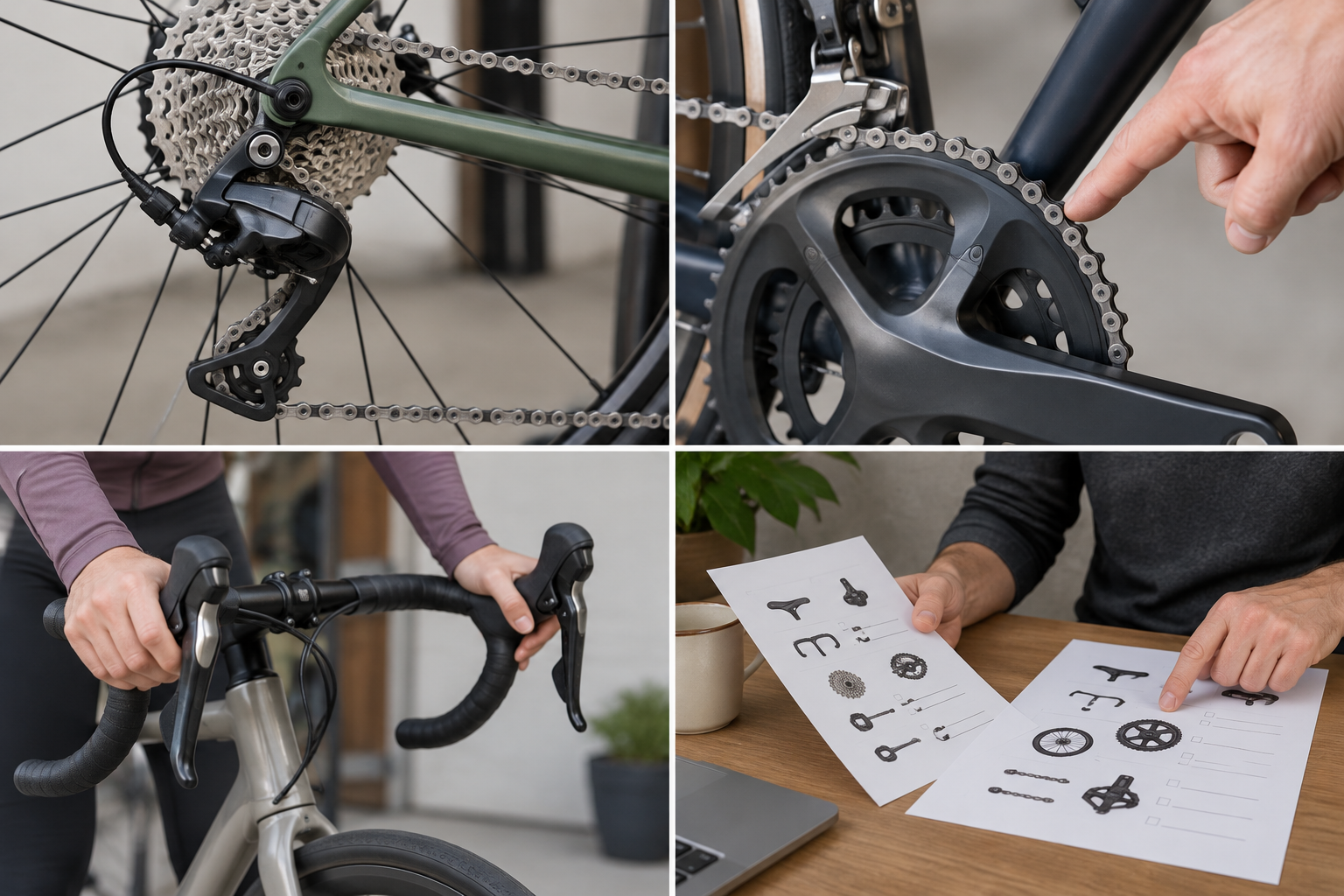
Record the model generation, rear sprocket count and whether it has one or two chainrings (the toothed rings beside the pedals). Two bikes wearing the same brand can have very different gearing and control systems.
Compare the lowest gear for your hills
The cassette is the stack of rear sprockets. To compare the easiest gear on the same wheel size, divide the smallest front chainring’s tooth count by the largest rear sprocket’s. A lower result means less distance per pedal turn and easier climbing at a given load.
For example, 34 divided by 34 is 1.00; 40 divided by 44 is about 0.91. These are arithmetic examples, not recommendations for combining parts. If wheel sizes differ, ask for gear inches or development (distance travelled per pedal turn) to compare like with like.
Try the controls, including brake reach
Mechanical shifting uses a cable to move the gear mechanism. Electronic shifting uses motors and batteries. The distinction changes operation and maintenance, but it does not tell you whether the levers suit your hands.
Have a retailer demonstrate the exact controls, then try them with your normal gloves and a suitable fit. Reach the brake levers from your usual hand position and make a permitted test ride. Ask about approved reach adjustments if the stretch is uncomfortable.
Think beyond the purchase price
Compare replacement chain, cassette and brake-pad costs and ask which local workshop supports the system. Electronic equipment adds a charging routine; ask which batteries need attention and how. Reliable everyday use matters more than winning a specification argument.
If upgrading, check exact manufacturer compatibility. Equal speed counts do not establish that chains, cassettes, controls or freehubs (the cassette mounting body) interchange. Brake-fluid requirements also differ between systems. Choose a complete supported combination before buying individual parts.
Mechanical versus electronic in daily use
| Choice | What you gain | What to check |
|---|---|---|
| Mechanical | No shifting battery to charge; cable-based control. | Cable condition, routing and adjustment; replacement cable access. |
| Electronic | Button-based shifting and system-dependent customisation. | Charging routine, battery arrangement, diagnostic support and replacement-part costs. |
Battery layouts differ between product families and generations. Do not assume that every Di2 or AXS system has the same wiring or uses interchangeable batteries.
On a test ride, try shifting and braking from the positions you actually use, with your normal gloves. Check control reach (distance from the grip to the lever), button feel and whether you can make a deliberate change without looking down. A system that fits your hands is more useful than an abstract brand winner.
Compatibility and servicing can decide the purchase
- Rear wheel: check the freehub (the wheel fitting that carries the cassette). A new cassette may require a different freehub or wheel.
- Chain and sprockets: matching speed counts alone do not establish compatibility. SRAM provides AXS compatibility charts; Shimano also publishes component-specific tables.
- Brakes: verify the exact fluid and service procedure in the manual. Never assume a fluid is suitable simply because another model from that brand uses it.
- Repair costs: ask your local workshop for chain, cassette, brake-pad and damaged-derailleur replacement estimates.
- Changing brands: budget for the whole approved system, labour and any wheel or crank interface changes, rather than just new levers.
Use Shimano’s compatibility information and SRAM’s compatibility maps. The exact model’s manual is the deciding reference.
Browse all guides · Explore cycling topics
New to the terminology? Read our plain-English cycling glossary.
Join the discussion
What has worked for you? Share your experience or ask a question about this article.
Sign in with GitHub to comment. Your comment and GitHub profile name will be public. Comments appear when posted and may be moderated afterwards.
Keep replies relevant and respectful. No spam, personal information or unsupported accusations. Discussion and privacy information.