
Free cycling tool
Bike gear ratio calculator
Understand your bike’s gears—or compare two setups for hills, speed and pedalling rate.
By Alex Rowan
Enter one bike’s gearing to see its lowest gear, top-end speed and pedalling rate. Turn on “Compare another setup” to compare Setup B with Setup A, including easier climbing gears and percentage differences.
New to bike gears? See what to enter
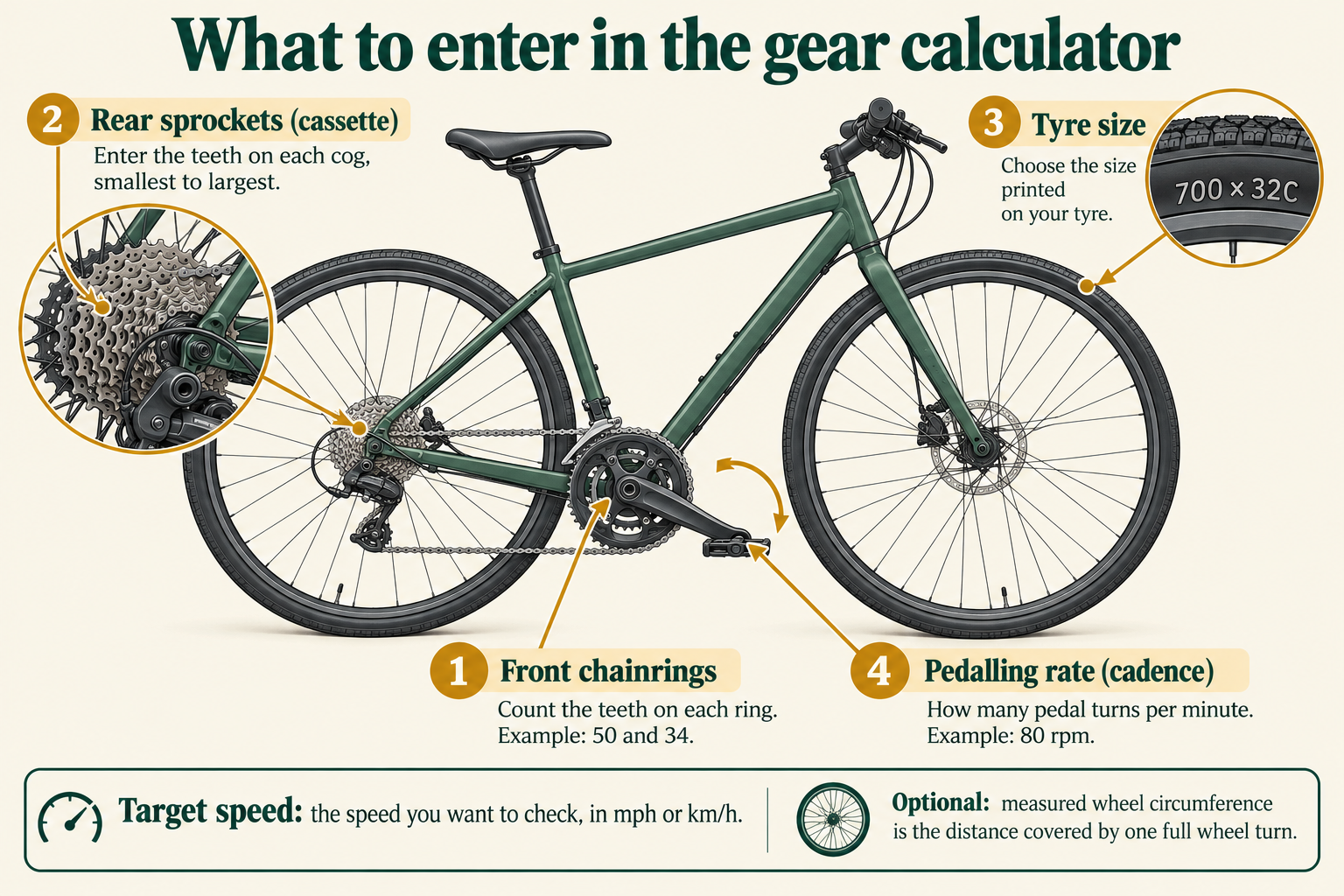
What should I enter?
- Chainrings: the toothed rings beside your pedals. A 50/34 double has two rings: choose two and enter 50 and 34 in separate boxes.
- Cassette: the group of rear sprockets. Check the markings or manufacturer specification for their tooth counts. “11-speed” describes the number of sprockets, not their teeth.
- Wheel rim diameter: choose a familiar tyre size from the dropdown, or select Custom tyre size and use the second number in the tyre’s ETRTO marking (its standard size), such as 32-622. Common diameters are 622 for 700C/29-inch, 584 for 650B/27.5-inch and 559 for many 26-inch wheels.
- Tyre width: the first number in 32-622 is 32 mm. Actual tyre height varies, so the calculated circumference is an estimate.
- Measured circumference: for a better speed estimate, measure one complete wheel revolution along the ground with the rider’s weight on the bike. This overrides the rim/tyre estimate.
Reading your results
A smaller lowest-gear number means lower gearing: you travel less distance per turn of the pedals. With the same wheels, a 34-tooth chainring and 34-tooth rear sprocket give a 1.00 ratio. Moving to a 40-tooth rear sprocket gives 0.85—a 15% reduction. At the same speed you would pedal about 17.6% faster. This does not mean a climb requires 15% less total energy.
Gear inches express gearing using the effective wheel diameter. Development means metres travelled per complete pedal revolution. These measurements allow meaningful comparisons between different wheel sizes. The speed shown is the speed your gearing produces at the entered cadence, not a prediction of how fast you can ride.
Before changing parts
The figures do not confirm that a cassette fits your bike. Check derailleur (rear gear mechanism) maximum sprocket size and total capacity, chain length, cassette/freehub fit, shifter compatibility and manufacturer instructions. The full chart includes mathematical combinations, including gears you may avoid because they put the chain at an excessive angle.
How the calculator works
Ratio = front teeth ÷ rear teeth. Estimated wheel diameter = rim diameter + twice tyre width. Circumference = π × diameter, unless you supply a measured circumference. Development = circumference × ratio. Speed in km/h = development in metres × cadence × 60 ÷ 1,000. Gear inches = circumference ÷ π ÷ 25.4 × ratio.
Understand gearing systems · Cycling jargon explained · Plan a touring trip
Reader comments
Share your gearing setup or ask a question. Please follow our discussion rules.