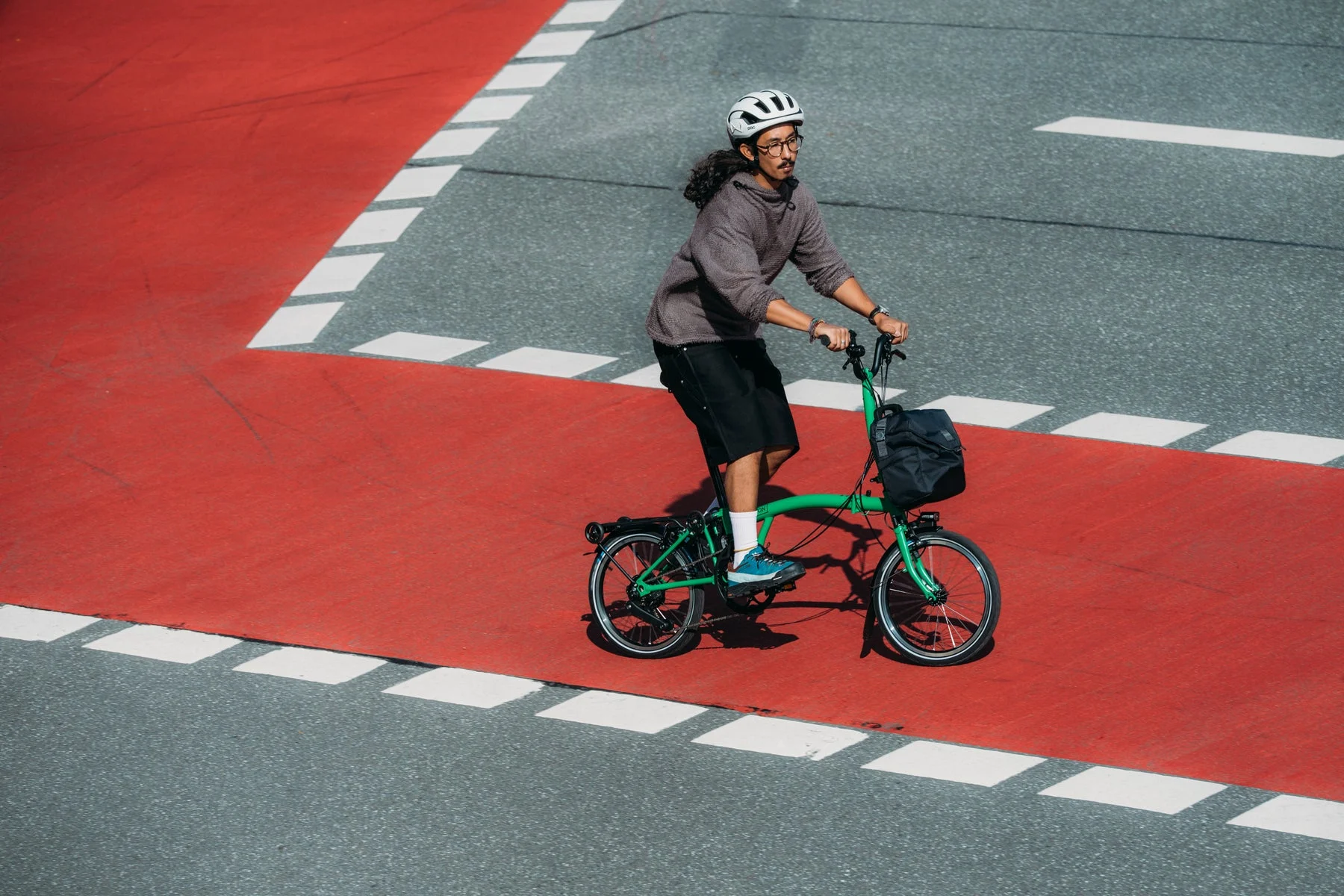
The best case for a Brompton may be your hallway. Or the train, the office or the stairs you face each evening. A folding bike and a full-size commuter can both make the ride enjoyable. The choice often rests on what happens at either end.
Start with the folder if its compact shape solves a real storage or travel problem. Start with a full-size bike if you ride door to door and have good parking. Then try the whole routine, including the lift, the luggage and the hill home.
Where will the bike live?
Measure the space where you plan to leave the bike. Include the doorway and the turn on the way in. A folded size on a website is useful, but it cannot tell you whether your hand, the bike and a door handle will all fit through a tight gap.
Think about the other people using that space. A bike in the hall should leave a clear route past it. At work, ask where it can go before you rely on bringing it indoors. “It folds” and “it can sit under my desk” are two separate questions.
For a full-size commuter, look at the daily parking job. Can you reach the lock points? Is the route to the space awkward? Can you put the bike away without moving half the room first? Good storage can make a full-size bike just as easy to live with.
If space is tight, try the actual folded bike there. A tape measure narrows the choice; the trial tells you whether the routine will annoy you twice a day.
Will you carry it comfortably?
Compact does not mean weightless. Ask staff to show you the fold, then try a short, safe lift if they allow it. Bring your work bag to see how you would hold both. A shop may have room for only a few steps; use the listed weight and folded size to judge the rest of your carry.
For stairs, think about the grip, the weight and whether you would see the steps. Do not turn a shop visit into a stair test without staff agreement and a safe space. If a short lift already feels hard, take that seriously before planning a daily carry.
Ask to see how the folded bike rolls. A smooth shop floor is a kind host. Station paving and door thresholds are less so. If you cannot try those surfaces, check the wheel size and handling advice rather than assuming it will roll just as well outside.
The full-size bike needs a lift test too if you carry it upstairs. Compare the exact builds. The Brompton's smaller package may be easier to hold close, while the full-size bike may offer a lift you prefer. Your hands get the final vote.
Walk through the train journey
A folder earns its place when it solves an awkward link. You ride to a station, fold before boarding and keep the bike with you at the other end. Check each operator's current rules for the exact service, including folded-bike size and luggage conditions.
Then think through the station itself. Where will you fold? Can you carry the bike while showing a ticket? Is there a lift, and what will you do if it is out of use? None of this needs a grand plan, but it is worth a trial before the first busy workday.
Check the workplace end as well. Permission to take the bike inside is useful only if there is somewhere suitable to put it. Include wet days: you may arrive with a damp bike and a coat to deal with too.
If you ride all the way and have good full-size parking, folding may solve little. Put that money beside the full-size bike's fit, luggage and equipment. The right choice should make the whole journey easier.
Compare the ride and the full bill
You may only be able to sit on the bike in a shop, or on a similar one in stock. Ask staff to hold it safely while you check reach and brake access. For a riding trial, ask about a demo bike or demo day. Check whether its size and gears match the model you want.
Wheel size alone will not tell you which bike feels better. Tyres, position and gears all play a part. Compare the lowest gear for your hill, rather than just counting the speeds. If a test ride is offered, check starts, stops and turns on the permitted route. Your own commute is useful context, not a required test course.
Add lights, a lock, bags and any fittings to the price. Ask about the service work and parts for the exact bike. Some choices make sense only after you include what you need to get to work on it.
We would pay for the fold when it removes a daily obstacle. If it stays unfolded in a secure ground-floor space, a full-size commuter is a strong place to start. Spend the saving on a setup that makes the ride pleasant.
When would we choose the Brompton?
For a ride to the station followed by indoor office storage, the fold can solve two problems in one trip. Try the carry and check the train rules first. That is a clear use for the feature you are paying for.
For a continuous ride with easy parking at both ends, compare full-size bikes first. You have more reason to focus on the ride, the bag and the equipped price. A folder can still be your favourite; it just needs to win on what you value.
Before buying, repeat the least convenient part of your day. Carry it up the stairs, move it through the door or fold it beside your work bag. If that part becomes easier, you have found a sound reason for the choice.
One model’s size, and the checks worth comparing
The Brompton UK C Line 12-speed listing checked on 12 October 2026 states a starting weight of 12kg and a folded size of 25.3 × 23 × 10.6 inches, approximately 64 × 58 × 27cm. These are model-listing figures: check the configuration and measure the actual bicycle before buying for a tight space.
| Your priority | Brompton consideration | Full-size commuter consideration |
|---|---|---|
| Frequent folding | Test fold, carry and rolling routine. | Usually needs a full-size storage position. |
| Rough surfaces | Try the exact tyres and wheel setup on your route. | Compare tyre width, pressure and suitable clearance. |
| Work luggage | Check approved front luggage and load limits. | Check compatible racks and pannier clearance. |
| Long uninterrupted rides | Check fit, gearing and comfort over your distance. | A wide choice of sizes and riding positions is available. |
Official specifications and guidance
Taking an e-bike by train?
Check every operator, battery restrictions and cycle reservations before paying for the journey. Read our e-bike train guide →

Comments & discussion
Have your say. No account needed; reader comments appear after review.
Leave a comment