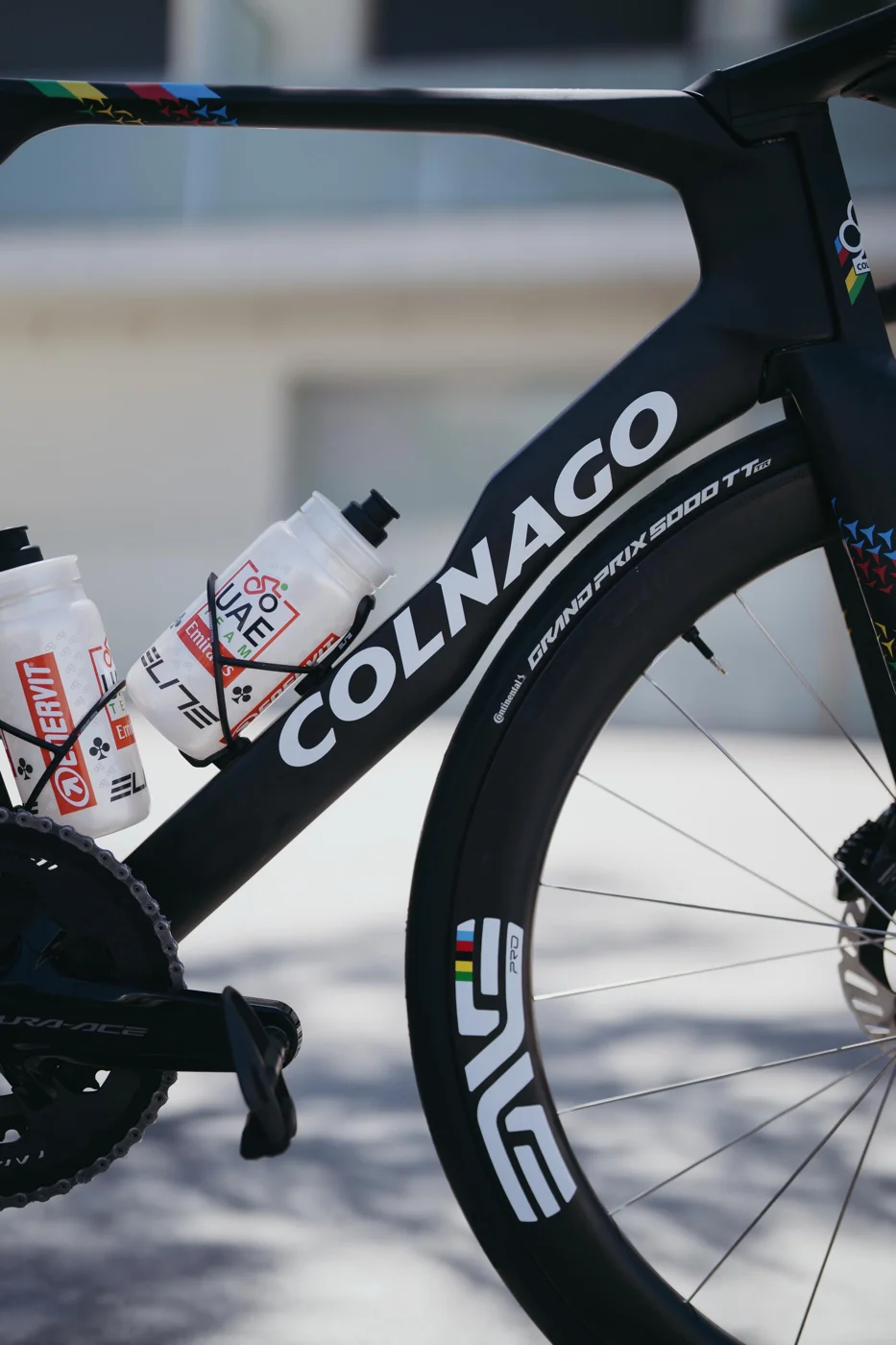
The useful answer is a dated build, not one bike for every race. Pogačar's bike in the ENVE Tour report discussed here is a Colnago Y1Rs. Its parts show what a team chose for that event. They do not make a shopping list that every rider should copy.
There is plenty to enjoy about a bike made for racing at that level. We look at the frame, wheels and riding position, then ask which ideas make sense on an ordinary ride. Admiring a machine is allowed to be the whole point; you do not have to find a reason to buy it.
The short answer: a Colnago, with a race-specific build
ENVE's report dated 24 July 2026 names the Colnago Y1Rs in the Tour build. It is a road race bike shaped to reduce air resistance. The team also has the lighter all-round V5Rs available. A different stage or event can lead to different choices.
The report lists ENVE SES 4.5 PRO or SES 6.7 wheels, 28mm Continental GP5000 TT TR tyres and Shimano Dura-Ace Di2 gears. It also names Carbon-Ti front chainrings and a custom Fizik saddle. These are parts from that report, not a promise about every bike Pogačar rides.
A shop Y1Rs may have a different build. Check its own parts list, size and price. The same frame name does not mean you are buying the same wheels, gears or fitting choices as the team.
A frame name is not the complete specification
The frame is the bike's main structure. The fork holds the front wheel. Add wheels, tyres, gears, bars and a saddle and you have the complete build. A team can change some of those parts to suit a course without changing the name on the frame.
Aerodynamics means how air moves around the bike and rider. Reducing drag [the air pushing back against you] matters in a fast race. It does not tell you whether the bike fits you, how much it weighs or how it will feel on your local roads.
For a shop purchase, start with size and the parts actually supplied. Ask what can be adjusted and what a change costs. A photograph of the team bike is a fine way to get interested. It is a poor way to check what is in your box.
What the wheel choice tells you
Rim depth is the height of the rim when you look at a wheel from the side. It is not the tyre width. Deep rims give a bike a bold outline and may be shaped with lower air drag in mind. Their look alone proves no saving.
Keep the wheel name and tyre name tied to the source date. A tyre's printed width is not a measured width on every rim. Nor can a race photo tell you a safe pressure for your load and wheel. Use the rim and tyre makers' limits for your own setup.
Tubeless tyres use a sealed tyre and rim system rather than a separate inner tube. That setup needs the right rim, tyre, valve and sealant [liquid that can seal small holes]. A race team's choice does not show that your wheels accept it. Ask a shop before buying parts.
The cockpit is a fitting decision
The cockpit is the handlebar and stem setup. The stem joins the bars to the fork's steering tube. An integrated design combines parts into one unit. That can look neat, but it may give you fewer cheap ways to change the reach or bar width.
Fit is not a detail to copy from a pro. Pogačar's position reflects his body and the work he does on the bike. Your shoulders, hands and back have their own needs. A low bar can be an expensive way to make a pleasant route feel longer.
Ask a fitter or shop which size can put the bars where you need them. Find out the cost of changing the stem or bar setup. If the exact bike is not in stock, compare its measurements with a bike that fits you. Sit on a supported shop bike where possible; do not assume a long test ride will be offered.
Take the lesson rather than the whole build
Use the build to ask a better question about your own bike. Do you need an easier gear on hills, more comfort on rough roads or a better hand position? Those are different jobs. One change made for the right reason may help more than a long list of race parts.
For example, a larger rear cog can make a hill easier if the gear system can take it. A wheel with a deeper rim does not give you that lower gear. Match the part to the problem before comparing its weight or appearance. Our gear calculator can show that distinction.
Price upkeep as well as the purchase. Ask about common wear parts, tyre options and who can service the bike. There is no shame in choosing a simpler setup for everyday use. The best lesson from a purpose-built race bike is to choose your own bike for its purpose.
Comments & discussion
Have your say. No account needed; reader comments appear after review.
Leave a comment