
A school in Prosperous, County Kildare, had removed its bike stands because they were not being used. Now, after works on the streets around it, the head says they are back and full each day. It is a small, clear sign of a change in how some pupils reach Scoil an Linbh Íosa.
Kildare County Council opened the €580,000 Safe Routes to School scheme on 4 November. The works cover the school entrance and nearby roads, with wider footpaths, raised crossings and changes at junctions. For families who want to cycle, the useful part is how those pieces help a journey fit together.
What the head has seen
The school’s head, Paul Cassidy, said in the council’s release that “the bicycle stands have been reinstated and are full every day”. He described a change from the time when the stands had no users. That is a useful account from the school, and it gives the opening more meaning than a ribbon-cutting on its own.
It is also worth being precise about what we know. The release gives no daily bike count or number of stands. It gives no before-and-after travel survey. Full bike stands are a reported sign of use, not a measured percentage rise. We cannot use that account to claim the works alone made a set number of families stop driving.
That does not make the account unhelpful. A parent who sees bikes arriving has a different starting point from one who sees an empty rack. A useful next step would be to count how many pupils ride and how often. Ask which parts of the trip still feel hard, too.
What has changed on the streets
The council lists a wider, rebuilt footpath outside the school and a raised crossing used by the school warden, which has been moved. There is also a new two-metre-wide footpath link to Goretti Terrace. A set-down space for buses and two accessible parking spaces form part of the scheme.
On nearby roads, six raised crossings come with junction tightening [making the space at a road junction narrower]. Picture a wide turn where a driver can sweep round in one smooth move. A tighter corner asks for a sharper, slower turn and can shorten the stretch a person on foot must cross. The layout still matters. The name of the change does not prove how each driver will behave.
The works include crossings near the R403 and Hatters Cross Road, plus a crossing where the road narrows on the R408. Pencil-shaped bollards and road markings help identify the school area. The bright features may be what catches the eye, but the shape of the road and the space to cross do much of the useful work.
A footpath is not automatically a cycle track. The council’s list should not be read as a promise of a new protected bike lane through the town. Nor does this report establish that every road leading to the school is now suitable for every child. The scheme changes parts of the route; a family still needs to look at the whole trip.
Start with the hardest part of the school run
For a parent thinking of trying the ride, start with the point that worries you most. It might be a turn from your own street, the last crossing or a place where parked cars block the view. Then see whether the new works change that point, or whether it remains outside the scheme.
A short route can still contain one hard crossing. If that crossing rules out the trip, a new rack at the gate will not solve it. On the other hand, a well-placed crossing and a clear last approach can make an already manageable ride feel much less of a gamble. That is why changes beyond the school fence deserve attention.
Explore the route with your child at a quiet time before using it for a school morning. Work out where to stop, cross and walk a bike if needed. Do not choose the busiest arrival time for a first attempt with a child who is still learning the route.
Drivers have a role too. Keep paths and crossing approaches clear, use the spaces set aside for stopping, and follow the school warden’s directions. A wide footpath loses much of its value if a car blocks the end of it. Those last few metres count just as much as the fresh surface.
Who paid for it, and what comes next?
The scheme is part of Ireland’s Safe Routes to School programme. Funding comes from Ireland’s Department of Transport through the National Transport Authority. An Taisce’s team helps run the scheme with councils and schools. Kildare says 20 schools in the county have been selected so far; that does not mean all 20 schemes are finished.
Our view is that Prosperous offers a useful lesson: begin with the trip children need to make, not just somewhere to leave a bike. Crossings, clear paths and room at the gate need to work as one route. The head’s account is a reason to look more closely at the result, while keeping the next round of checks practical and open.
The facts and head’s statement come from Kildare County Council’s 4 November announcement.
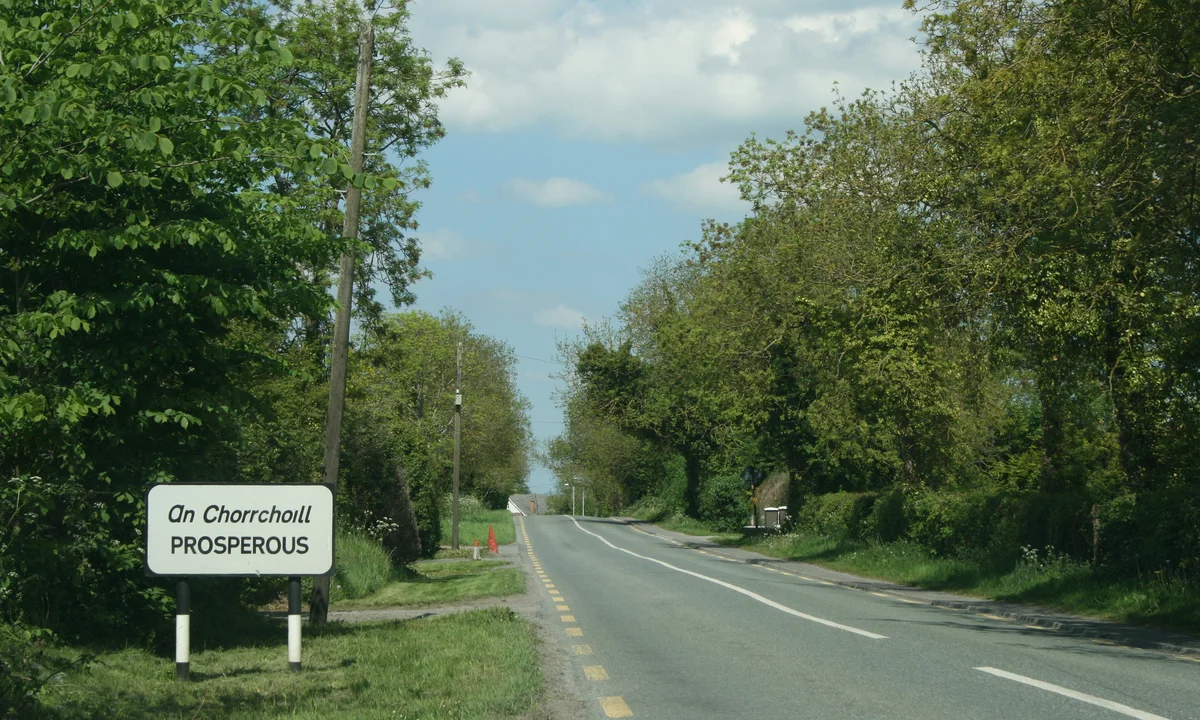
We checked the source on 5 November 2026. The lead photograph is an older view at the edge of Prosperous. It locates the town; it does not show the school or the completed works.
Comments & discussion
Have your say. No account needed; reader comments appear after review.
Leave a comment