
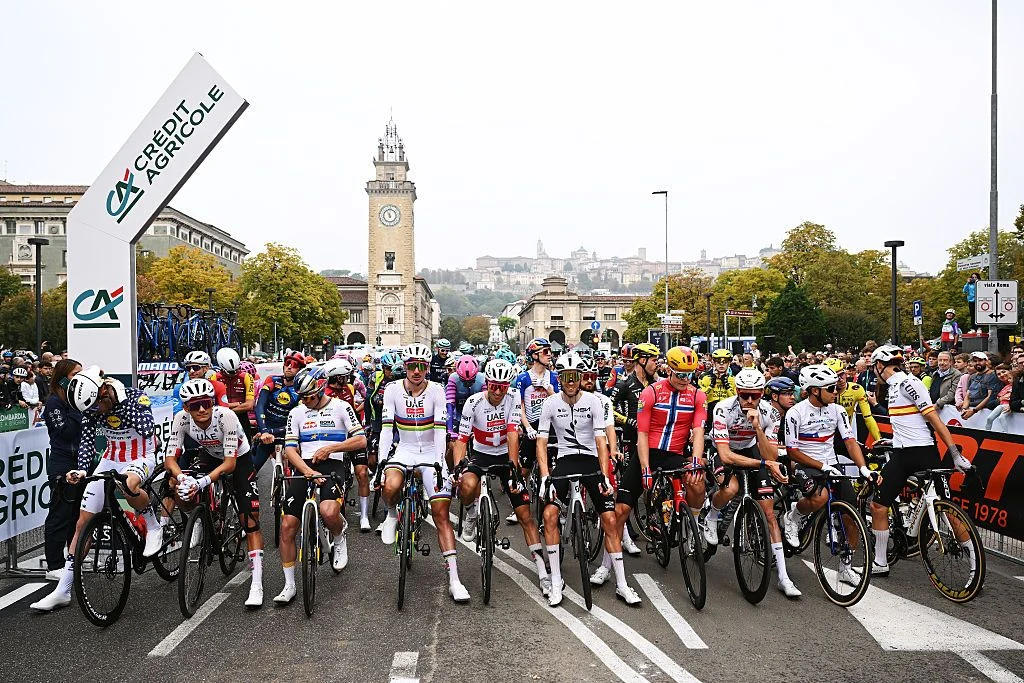
The start signal had been given, but the riders stayed put. At Il Lombardia in Bergamo on 10 October, the peloton [the main group of riders] held a five-minute protest to draw attention to vehicles putting cyclists at risk inside races.
Pinarello Q36.5’s account confirms that the stand followed the neutralised-start flag [the controlled opening before full racing begins]. The race subsequently continued from Bergamo to Como. The protest was about safety across professional cycling, rather than a refusal to complete this particular event.
Evenepoel asks organisers for safer racing
Remco Evenepoel addressed the crowd with a microphone. His appeal to future race organisers included:
“To the organisers who organise races in the future, please make sure that we can race safely”
The immediate issue was the danger created when vehicles and racing cyclists come into conflict on a course. Riders were using the pause to make that concern visible before resuming the competition.
Why Pidcock wanted to stop four days earlier
At Tre Valli Varesine on 6 October, Pinarello Q36.5 says Marcel Camprubí and British rider Thomas Gloag were struck by a police motorbike. In the team’s published account, Pidcock described the motorcycle travelling against the direction of the race.
He explained his immediate reaction:
“First of all, I wanted to stop the race, stop racing myself. I was mad.”
According to that account, Camprubí continued, while Gloag stopped racing and required stitches to his knee. Pidcock added:
“This shouldn’t happen.”
These are attributed accounts from an affected team and its rider. They establish what the team publicly reported; they do not replace an independent investigation or determine legal responsibility.
What needs to change?
Race vehicles provide essential support, including medical response, security and organisation. The safety question is how those functions are managed around riders: access to the course, movement within the convoy and communication when something goes wrong.
Safety was already on the governing body’s agenda before the protest. In an 8 October announcement, the UCI [cycling’s international governing body] identified it among the issues in its road-cycling reform work and described a steering committee involving rider, team and organiser representatives. That earlier announcement should not be presented as a new response to the 10 October demonstration.
The team reports do not identify a specific new safety measure agreed as a result of the protest. The next useful development is a clear, attributable explanation of the changes organisers and governing bodies will make—not simply another expression of concern.
Team account of the protest · Pidcock’s published comments · UCI’s earlier reform announcement
Join the discussion
What has worked for you? Share your experience or ask a question about this article.
Sign in with GitHub to comment. Your comment and GitHub profile name will be public. Comments appear when posted and may be moderated afterwards.
Keep replies relevant and respectful. No spam, personal information or unsupported accusations. Discussion and privacy information.